

The llms.txt specification describes a standard file that publishers can place at the root of their domain to help AI language models understand the structure and content of their site. By October 2025, over 844,000 sites had implemented some version of it. Yoast SEO and AIOSEO both added free llms.txt generation in 2025. It has become a standard checkbox in the AI visibility conversation.
So what is actually in an llms.txt file, does it actually work, and where does RocketCite’s implementation go beyond what existing tools offer?
What llms.txt contains
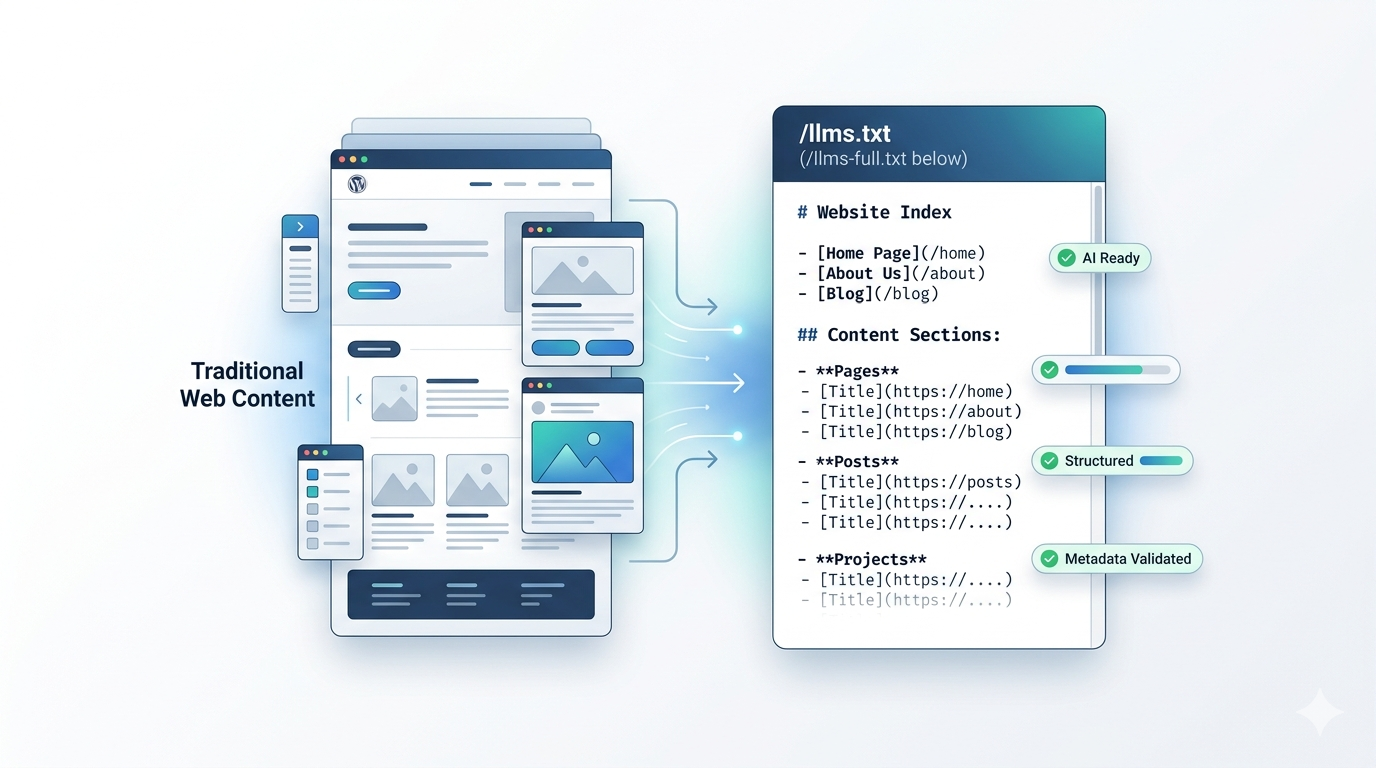
The specification defines a markdown-formatted file with a structured layout: an H1 heading with the site name, a blockquote with the site description, and H2-headed sections linking to key content. The file is placed at yoursite.com/llms.txt.
The companion file, llms-full.txt, includes the full content of linked pages inline, creating a single document containing the entirety of the site’s AI-accessible content. For smaller sites, this allows an AI system to ingest the full content in a single request.
Does it work?
The honest answer: there is no confirmed evidence that major AI platforms actively use the file. Semrush tested their own llms.txt from August to October 2025 and recorded zero bot visits from GPTBot, PerplexityBot, Google-Extended, or ClaudeBot during the testing period. The file has not been officially endorsed by OpenAI, Google, Anthropic, or Perplexity as part of their crawling process.
RocketCite takes the position that it is a low-effort, no-downside implementation with forward-looking value. The file takes minutes to generate correctly. If major AI platforms do adopt it, sites with a correctly implemented file will benefit. Sites without one will need to retroactively add it. The cost of implementing it correctly now is minimal.
The baseline: what Yoast and AIOSEO provide
Both Yoast SEO and AIOSEO generate an llms.txt file listing the site’s published content. This covers the specification’s basic requirements. For a site that already has Yoast installed and wants a straightforward llms.txt, Yoast’s implementation is functional.
The limitations are what you would expect from general-purpose SEO plugins that have added llms.txt as a feature: they do not know which of your pages have AI-optimized markdown endpoints, which pages have been crawled by AI bots, which pages score well on AI readiness criteria, or which content is most likely to be cited by AI systems.
What RocketCite adds
RocketCite generates both /llms.txt and /llms-full.txt from the same content selection and markdown pipeline that powers the rest of the plugin.
The admin preview panel shows the generated llms.txt alongside per-link AI readiness score indicators. When a page linked in your llms.txt has a low AI readiness score, it is flagged. The llms.txt index is meant to guide AI systems to your best content, not to your complete content. RocketCite makes the quality of what you are pointing to visible.
The file supports configurable content selection: choose which post types, categories, and individual pages are included. Priority ordering puts sticky posts and manually prioritized content first. For large sites, size limits and pagination are configurable to keep the file within practical bounds.
The serving configuration includes proper caching headers: ETag and Last-Modified for conditional request support, Cache-Control with configurable max-age. Scheduled regeneration runs on an hourly or daily schedule based on your settings. Manual override editing allows the generated file to be customized when the automated output needs adjustment.
For WooCommerce sites, product categories and individual products can be included in both files, with each product linking to its markdown endpoint where the product description, attributes, pricing, and reviews are available in AI-readable format.
The manual override
The ability to manually edit the generated llms.txt file is deliberate. Automated generation does not always produce the ideal index for every site’s content strategy. A publisher might want to emphasize cornerstone content, exclude content in specific categories, or add custom sections the automated system would not produce. RocketCite preserves manual edits through regeneration cycles when an override is in place, warning the administrator if the auto-generated version would differ significantly.
What is an llms.txt file?
Does llms.txt actually help with AI visibility?
What’s the difference between llms.txt and llms-full.txt?
If Yoast or AIOSEO already generates llms.txt, why would I need RocketCite?

Be the first to know when Rocketcite Pro launches
Join the waitlist and get exclusive early access, priority support, and a founding-member discount. No spam, ever.
No credit card required. Unsubscribe anytime.